Who Really Owns Manchester?
The beginning of a series breaking down who owns the most valuable assets in Greater Manchester
At The Northern Rose we deal with social issues across Manchester. We can bring attention to the problems like housing affordability, working conditions, and cost of living, but where do we look for answers? An obvious answer is local government. We can talk to local councillors, request information from government departments, and try to contact the mayor. All these people are accountable to the public and can be replaced through democratic means if they act against our interests.
However, a large part of Manchester is not publicly owned and many of the decisions that influence people within the city are not directly within the control of our elected officials. So, to get a better idea of exactly who, and what, is influencing these factors, we’ve sought to understand who owns large parts of the city.
Do we know who owns what?
Walk along the Manchester Ship Canal and you’d think you were looking at publicly owned infrastructure, like the tram lines or the town hall. You’d be wrong. The entire thirty-six-mile waterway, from Eastham Locks to Salford Quays, belongs to a single private company. So does the Bridgewater Canal. So does most of Trafford Park.
Look up at the skyline instead and the same story repeats. Most of those towers stacking up around Deansgate and Greengate belong to one developer. If you work in Manchester, most of the office blocks are owned by one property firm. The land the BBC sits on, the land under Spinningfields, and the land the next high-rise luxury flats will be built on, almost none of it is publicly owned, publicly accountable, or, in most cases, even publicly understood.
Manchester often sells itself as regenerated from the bottom up, a city of workers who built themselves a diverse and thriving metropolis. The truth is a handful of private companies, most of them family-controlled, one of them barely known, decided what large parts of this city would become.
The family at the top: Peel Group
Peel Group is not controlled by a pension fund or accountable to public shareholders. It’s a private, family-controlled empire, roughly two-thirds owned by the Whittaker family, with a further quarter held by the Saudi conglomerate Olayan Group. At the top of the family sits John Whittaker, a man who has spent five decades quietly assembling one of the largest privately held landbanks in Britain, and who mostly operates in the shadows.
What do they own?
Peel owns the Manchester Ship Canal outright, with ambitions to grow container traffic through it more than tenfold by 2030. It owns the Bridgewater Canal too. Through Peel L&P, its property arm, it controls TraffordCity which equates to the Trafford Centre’s surrounding 3.5 million square feet of retail, leisure and office space, drawing forty million visits a year, plus Trafford Palazzo, and a further £2.6 billion of investment planned over the next two decades. It’s behind Manchester Waters (formerly branded Trafford Waters), a mixed-use development that’s already delivered 850 homes across three gateway sites, with a 24-storey tower under construction and a fresh masterplan for the 25 remaining acres at Pomona Island submitted to Trafford Council at the end of last year.
Through Peel Ports, it plans to open Port Salford, a £400 million tri-modal freight terminal built in partnership with Salford City Council. It runs Barton Aerodrome and Manchester Heliport. It’s behind Cammell Laird’s shipbuilding and repair operations via the APCL joint venture. It is, by tonnage, the UK’s second-largest ports operator.
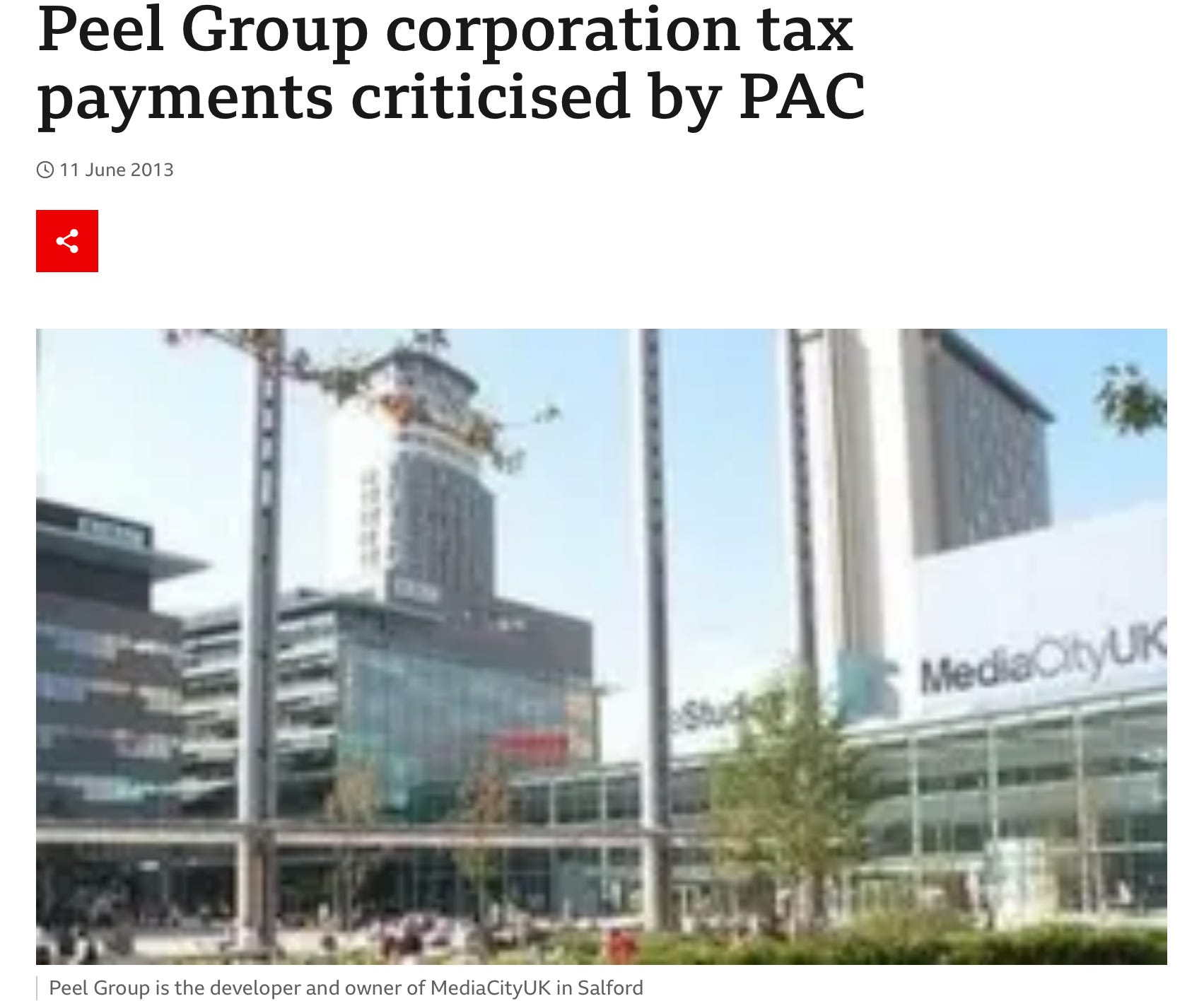
There’s also MediaCityUK, which Peel L&P describes on its own site as having been one of their central projects, and “one of the most transformational regeneration projects in Europe at the time of its delivery”. The freehold has since passed to Landsec, but the branding exercise worked, and MediaCityUK is often thought of as a Peel achievement, a gift to the city, rather than being a very profitable regeneration on land Peel happened to control.
Peel’s power
In 2010, Peel Energy proposed a 200,000-tonne biomass incinerator on Ship Canal land in Davyhulme, known as Barton Renewable Energy Plant. Residents organised as the Breathe Clean Air Group and the group marched through Urmston. Trafford Council’s planning committee rejected the scheme unanimously, citing both air-quality fears and harm to the “vitality and confidence” of Davyhulme, Flixton and Urmston. Peel appealed. In 2014, a judge overturned the council’s legal challenge and found for Peel anyway, ruling that the benefits outweighed the health concerns, at which point Trafford’s own deputy council leader was left threatening judicial review against a decision made in Whitehall, about land in his own borough, against the wishes of his own residents. That’s what it looks like when a large private landowner’s planning appeal can simply overpower a unanimous local vote.
In 2011, Peel sold the Trafford Centre to Capital Shopping Centres for £1.6 billion, which was then the most expensive property acquisition in British history, taking £700 million of the price in shares rather than cash. Peel reportedly avoided paying around £200 million in capital gains taxes because it took payment in shares. Peel kept buying more, becoming Capital Shopping Centres’ largest shareholder within a year. That company became Intu, which collapsed into administration in 2020, and those shares should’ve been worthless, although Peel claimed Intu’s collapse had no impact on them. This is a useful reminder of the opaqueness of Peel and shows it isn’t infallible with a flawless record on investments. It’s a firm that seemingly made a very large, very leveraged bet on retail property and lost, even as it kept the far more durable asset (the land underneath) for itself.
The airport stakes tell a similar story of failure. Peel owned a 76% stake in Liverpool John Lennon Airport in 1997 but has now sold its entire stake. Doncaster Sheffield Airport, which it owned outright, closed entirely in November 2022. This decision cost many jobs and reduced regional connectivity across South Yorkshire and was a decision made by a private landlord answerable to nobody but itself. The airport looks set to reopen in 2027 with public funding and support from Andy Burnham.
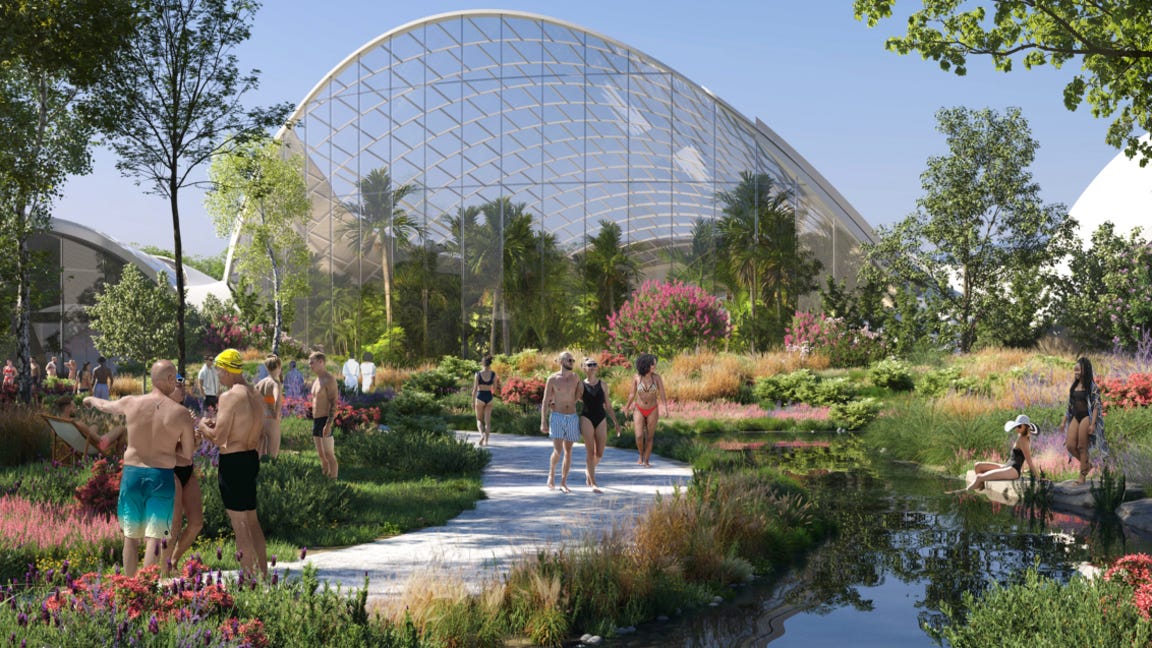
And then there’s Therme Manchester next to the Trafford Centre. A £450 million “wellness resort”, Europe’s largest, being built on land that was under Peel’s control until very recently. It’s not a Peel project in ownership terms. But it’s Peel’s pattern in miniature: a huge, privately financed leisure destination on former industrial land, arriving with promises of jobs and regeneration, on a site that used to be something else entirely, decided somewhere well above the heads of the people who’ll live next to it.
What’s the problem?
Journalist Andy Spinoza, in his book Manchester Unspun, described Whittaker as an “aggressive property entrepreneur” and a “secretive tax exile” who lives on the Isle of Man. Peel’s ultimate controlling company, Tokenhouse Ltd, is itself registered on the Isle of Man, one of the UK’s favourite tax havens. The arrangement runs like this: a Crown dependency company, controlled by an offshore-based family, sits atop a family empire whose entire value is generated by land, water, rent collection, and infrastructure inside Greater Manchester. The wealth is extracted here.
Peel has not always been free of scrutiny. In 2013, Baroness Margaret Hodge was chair of the Public Accounts Committee, where she accused Peel of not paying enough corporation tax. A spokesperson for Peel stated that they pay the “appropriate level of tax”, and since then, there has seemingly been no further government scrutiny of Peel. The Herald reported in 2014 how Peel avoids taxes in Glasgow, but nothing is being done to redress the issue.
Contrast the Whittaker family’s public profile with Manchester’s other big developers. Tom Bloxham and Tim Heatley built careers on being visible, quotable, and endlessly profiled. Whittaker built one on being none of those things. An empire this size, run this privately, by a family that avoids interviews, ought to be scrutinised much more. Instead, their wealth extraction seems to be accepted as a norm.
Not all bad
It’s important to recognise that Peel has done some good things for Manchester and the North West. Peel has given the council a free 125-year lease to land in Castlefield for housing for the homeless. Embassy Village has reportedly been a huge success and Bev Craig has described it as an example of how “good people can do good things”. Additionally, their projects do create jobs for locals and stimulates the local economy, although we don’t have the figures to tell us exactly how beneficial these projects are.
However, the question we need to ask is whether this philanthropy and job creation make up for the resources that are siphoned away from the region through a lack of tax revenue, and we would suggest that it does not. If Peel paid fair taxes, then many more jobs could be created and there would be more resources available for council funding of essential projects.
Who actually decided this?
None of what has been covered here is illegal. None of it is even unusual, by the standards of how post-industrial British cities get rebuilt. But that’s the point. These activities shouldn’t be so ordinary. Our legal architecture and local governments enabled a handful of private families to own the physical infrastructure of a major English city, without scrutinising their tax affairs, and we’ve simply come to accept that this is the way things are.
Manchester talks a good game about being a city that regenerated itself. What’s less often said is how much of that regeneration happened on land owned by a small handful of private families and funds, on terms those owners set, with the profits flowing to the Isle of Man, to Monaco, to a Canadian pension fund, or to a London Real Estate Investment Trust. Profits often seem to leak out the region and not back to the people who actually live, work, and contribute to the local economy. If you want to know who actually decided what Trafford Park looks like, who gets to build the canal-side flat and who doesn’t, whether Davyhulme gets an incinerator or Great Jackson Street gets another tower on a public loan, you’re not looking for a councillor. You’re looking for a handful of men who, between them, rarely give an interview.
Peel is just one part of the puzzle, and in subsequent articles we’ll look at Bruntwood, Renaker, Urban Splash, Capital & Centric, Allied London, and Landsec — the other large asset owners across Manchester, to break down exactly who owns the city.