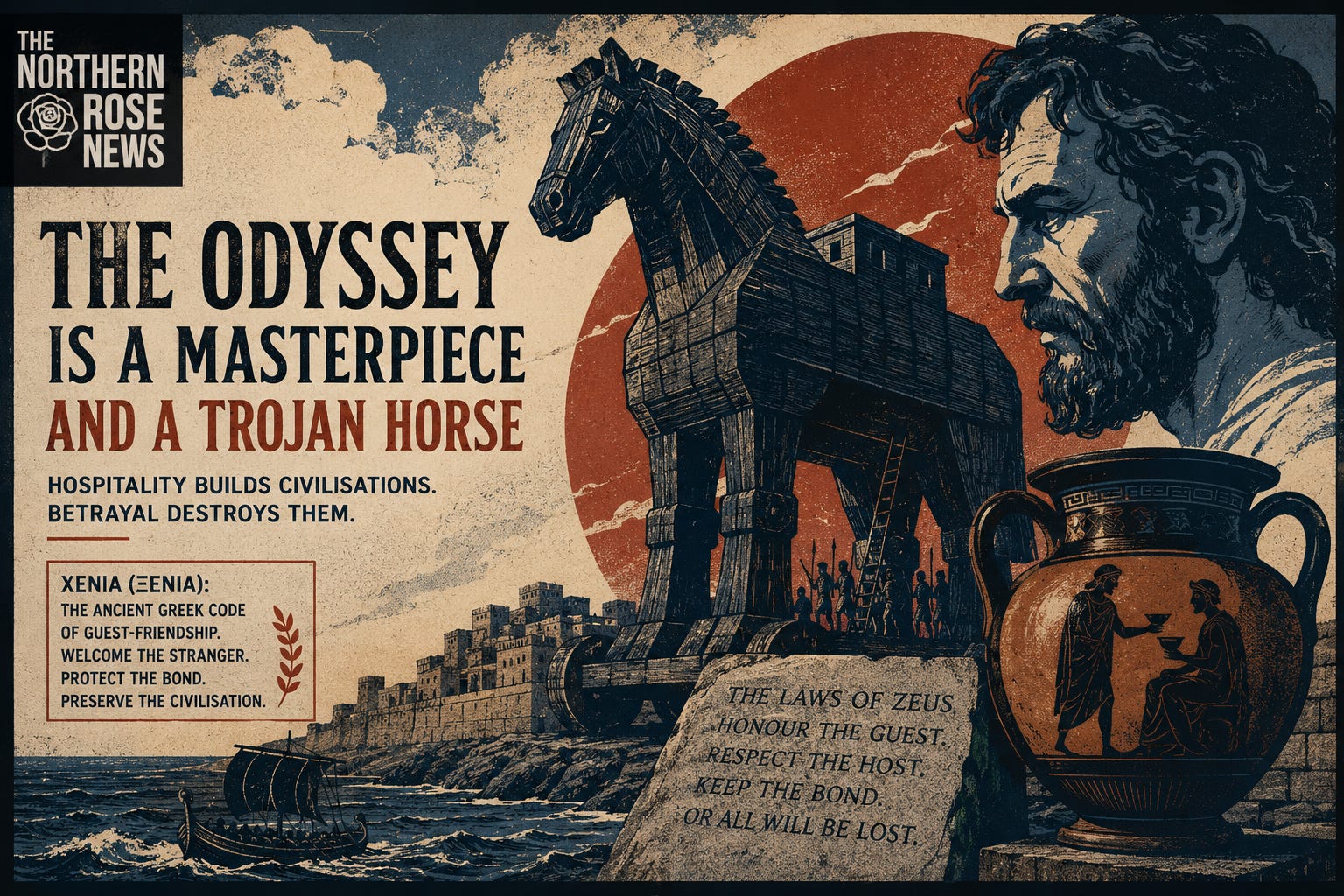
The Odyssey is a Masterpiece and a Trojan Horse
The Odyssey delivers a pertinent political message, at the moment it is needed most.
Christopher Nolan’s interpretation of The Odyssey is a brilliant retelling of a story older than the Bible. Nolan nails many aspects of the story that only reiterate that he is the greatest modern director. However, Nolan does something even more significant than producing a cinematic masterpiece, he sent a deeply meaningful political message. The genius of what Nolan has done is that the message isn’t in your face, it isn’t telling you what to believe, but like any great cultural product, it weaves a message into the narrative which shows the benefits of certain political position.
What is the Message?
Throughout the film, the “Laws of Zeus” recur as the moral spine. These are Nolan’s dramatisation of xenia (ξενία), the Greek code of guest-friendship. A host was obligated to welcome a stranger, offer food, shelter and protection, and hold off interrogating them until their needs were met. A guest, in turn, was expected to behave respectfully, not abuse the host’s generosity, and reciprocate where possible. Crucially, xenia wasn’t abstract charity but a binding relationship, often expected to carry across generations, knitting families and communities together through mutual obligation. Breaking it wouldn’t just offend a stranger but corrode the very cultural norms that makes strangers safe to encounter at all.
What Happens When You Break Xenia?
The Odyssey’s most important message is that when we stop following this law of hospitality, or we abuse it, it erodes trust in the whole system. Odysseus’ disastrous journey back from Troy demonstrates the catastrophic impact of his own role in breaking the rule of xenia. The Trojan Horse abused the laws of hospitality: it was presented as a gift, only to become the weapon that destroyed the Trojans. As the story spread across the Mediterranean, people became suspicious of anyone seeking hospitality, worrying that any guest might be concealing a Trojan Horse of their own. Nolan perfectly conveys how deeply that single act of betrayal damaged trust in the gifts of strangers, and in the laws of xenia, across the ancient world.
When Odysseus finally reaches Ithaca, he finds his own crime replicated. A household of suitors who have taken up residence as guests while plotting to seize everything within it. Odysseus eventually rescues his home, but there is no clean redemption. He goes into exile all the same, as the man who broke xenia. He may have restored it under his own roof, but he cannot undo what he did at Troy. Nolan’s argument isn’t really about gods punishing mortals. It’s that a society which stops policing the obligations owed to strangers—which stops being good hosts to guests and guests to hosts—eventually eats itself.
A Warning, Not a Prophecy
The timing of this message is pertinent, arriving as the political right openly campaigns on the idea that migrants and refugees are burdens to be turned away rather than obligations to be honoured. Nolan’s film sends a stark warning: when guests abuse the trust extended to them, hosts stop extending it, and when hosts turn strangers away on principle, they abandon the very obligation that once bound societies together. Either way, the bond breaks, and everybody loses. That, more than any battle with a Cyclops, is the real danger Nolan is asking us to sit with.