

Kamikaze Dolphins and Distraction Techniques
The Propaganda Behind Military Marine Mammals
Every few years, a story about military dolphins surfaces and briefly dominates the news cycle. In May 2026, it happened again. I’m going to tell you why.
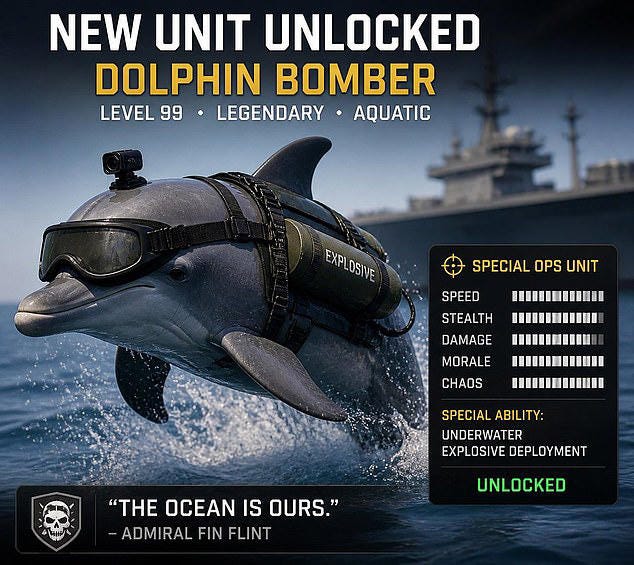
In a recent press conference US Defence Secretary Pete Hegseth was asked whether Iran was planning to deploy “kamikaze dolphins” to attack American warships in the Strait of Hormuz. Hegseth responded: “I cannot confirm or deny whether we have kamikaze dolphins, but I can confirm they don’t.”
We can’t say for certain whether this question was planted, but the Pentagon has consistently restricted who can report and ask questions about their activities, and there is a very clear benefit to such a question. The question arrived at a moment where congressional scrutiny of the war is growing. A question about kamikaze dolphins is not just funny—it is useful. It consumes airtime, generates social media engagement, and ensures that the lead clip from that briefing is a quip rather than a question about civilian casualties or legal authorisation.
Is There Any Truth to the Claim?
The reason these stories are so effective is that they contain a kernel of documented truth. The US Navy has run a Marine Mammal Programme since the 1960s, using dolphins for mine detection and harbour protection. The Soviet Navy did the same, and when the USSR collapsed, Ukraine inherited the programme and then sold 27 animals to Iran in 2000, along with the programme’s chief trainer. Russia revived its own dolphin units after annexing Crimea in 2014. The infrastructure for military dolphins genuinely exists. That is what makes the “kamikaze” elaboration so potent, it combines absurd fiction onto a credible foundation.
Propaganda and Turning the News into Entertainment
The purpose of planting such a question is to shift the news environment into focusing on an entertaining and humorous topic. This is not the first time that the military use of dolphins have become the focus of a news cycle. The Russians have been accused of using dolphins to guard military convoys and North Korea might have a fleet of communist dolphins trained to spread communist ideology through marine warfare.
The role of this propaganda is twofold; firstly, It frames the adversary—whether that be Iran, Russia, or North Korea—as both cruel and technologically desperate, a country reduced to strapping bombs to animals because it lacks the precision technological weapons to compete.
Secondly, the propaganda hijacks the news cycle and the media end up reporting on this rather than on the actual events taking place. It fills the available attention space with something absurd enough to be funny, harmless enough to share, and memorable enough to crowd out harder questions about what is actually happening in the war.
Comedy to Distract and Entertain
What makes the current moment genuinely interesting is that Iran has apparently recognised this dynamic and decided to play along rather than fight it. As I have written about for The Conversation, Iran’s social media operation has become adept at using humour and memes to reach audiences who don’t follow conventional news. Both sides seem to have concluded that absurdity travels further than argument. The dolphin, improbably, has become a weapon in meme warfare.
The next time you hear a bizarre military story in your feed, it is worth pausing and thinking about the purpose it serves. The laughter it provokes may be the intended reaction.