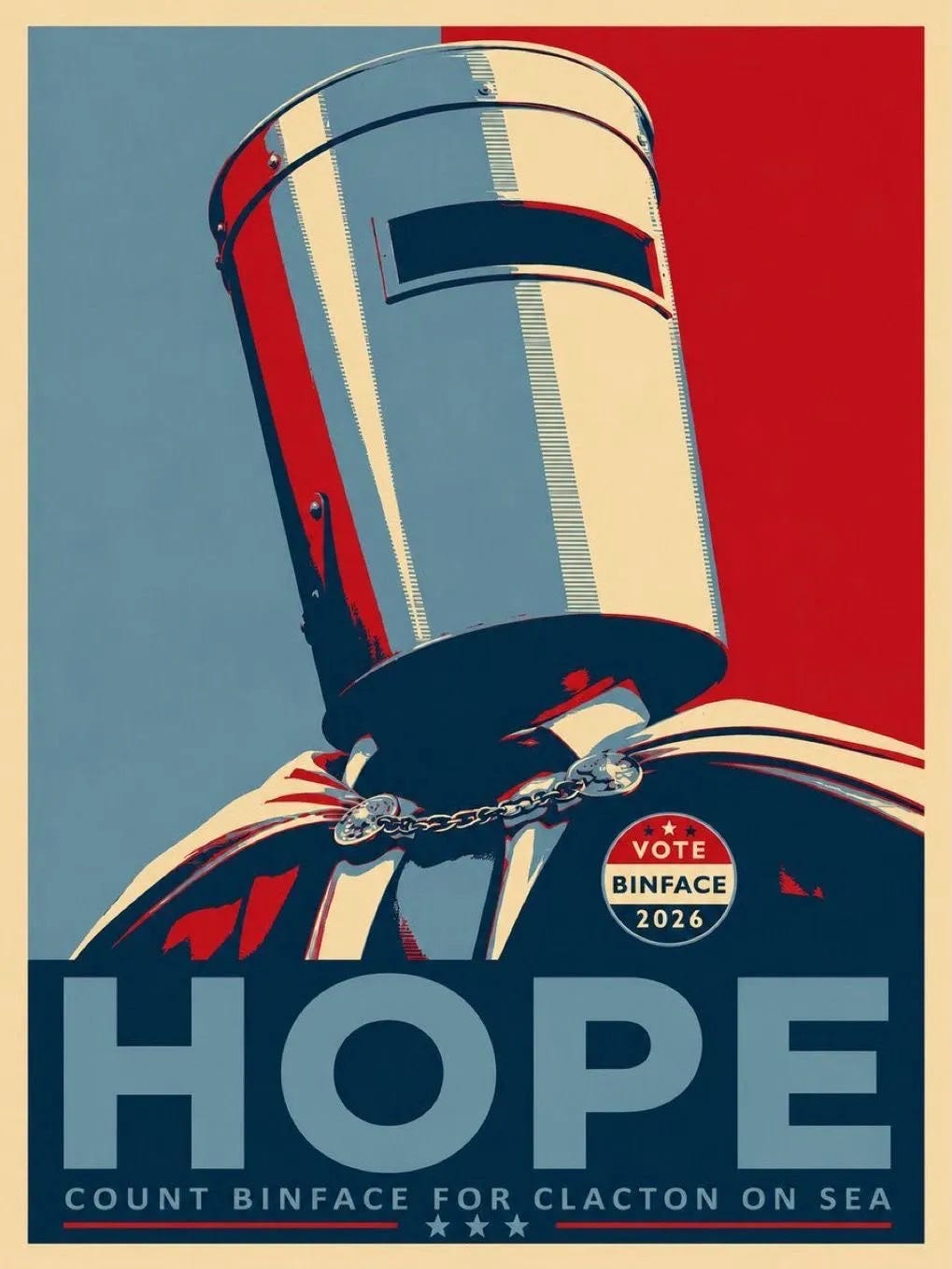
Could Count Binface beat Nigel Farage in Clacton? This idea sounds like rubbish. Which is precisely why it’s worth taking seriously.
Beneath the humour, there is a serious political question: could Britain’s first-choice intergalactic bin collector exploit the same electoral maths that delivered victory for Reform? Because when you lift the lid on Clacton’s result, things get interesting.
In the 2024 election, Farage won with 21,225 votes, taking 46.2% of those cast. But dig through the numbers and there is another story.
Farage won less than half of votes cast. More importantly, his votes represented only around 27% of those eligible to vote. Nearly three-quarters of eligible voters either backed another candidate or stayed at home. That leaves plenty of material for a candidate willing to rummage around in the electoral bins.
If every party opposed to Reform decided to throw their differences in the same recycling bin and endorse one challenger, Count Binface, then there is a genuine opportunity. The combined non-Reform vote in 2024 exceeded Farage’s total by more than 3,500 votes. If every voter who backed another party simply voted for Binface instead, Farage would lose.

Of course, politics is not a simple bin collection round and voters might not get on board the bin lorry. We’d be right to expect that the Conservatives would never vote for a candidate backed by Labour and Labour voters would refuse to support a candidate endorsed by the Conservatives. Others might just refuse to vote. However, Binface is largely apolitical. With policies like building one affordable house and capping the price of ice-cream, all parties could realistically back him and not compromise their political agenda.
So, if Farage kept every one of his 21,225 votes, Binface would need to persuade roughly 86% of those who voted for another party in 2024 to unite behind him. Maybe that’s wishful thinking. But there is another landfill of support: the people who didn’t vote.
Turnout in Clacton was only 58.4%. More than 32,700 eligible voters stayed home. If a unity campaign failed to consolidate every opposition voter, it wouldn’t necessarily be fatal. Winning over a relatively small fraction of those non-voters could make up the difference. I’ve written about the electoral appeal of humour and Binface’s campaign has the potential to reach and mobilise the typically disengaged from politics.
Even if only 80% of anti-Reform voters backed Binface, he would be around 1,400 votes behind Farage. Convincing just a few thousand non-voters to turn up would be enough to tip the scales.
The question is not whether Count Binface personally has a realistic route to Westminster. It is whether a divided opposition can avoid throwing away an opportunity. That is the real lesson from this absurd thought experiment.
This isn’t really about Count Binface. It’s about the mechanics of Britain’s electoral system. Under First Past the Post, elections are often won not because one candidate commands majority support, but because everyone else is divided.
Could Count Binface become MP for Clacton? Probably not. Could a united challenger defeat Nigel Farage? The numbers suggest the answer is yes.
Count Binface currently isn’t quite binevitable, but there is a real path to Bindependence Day.