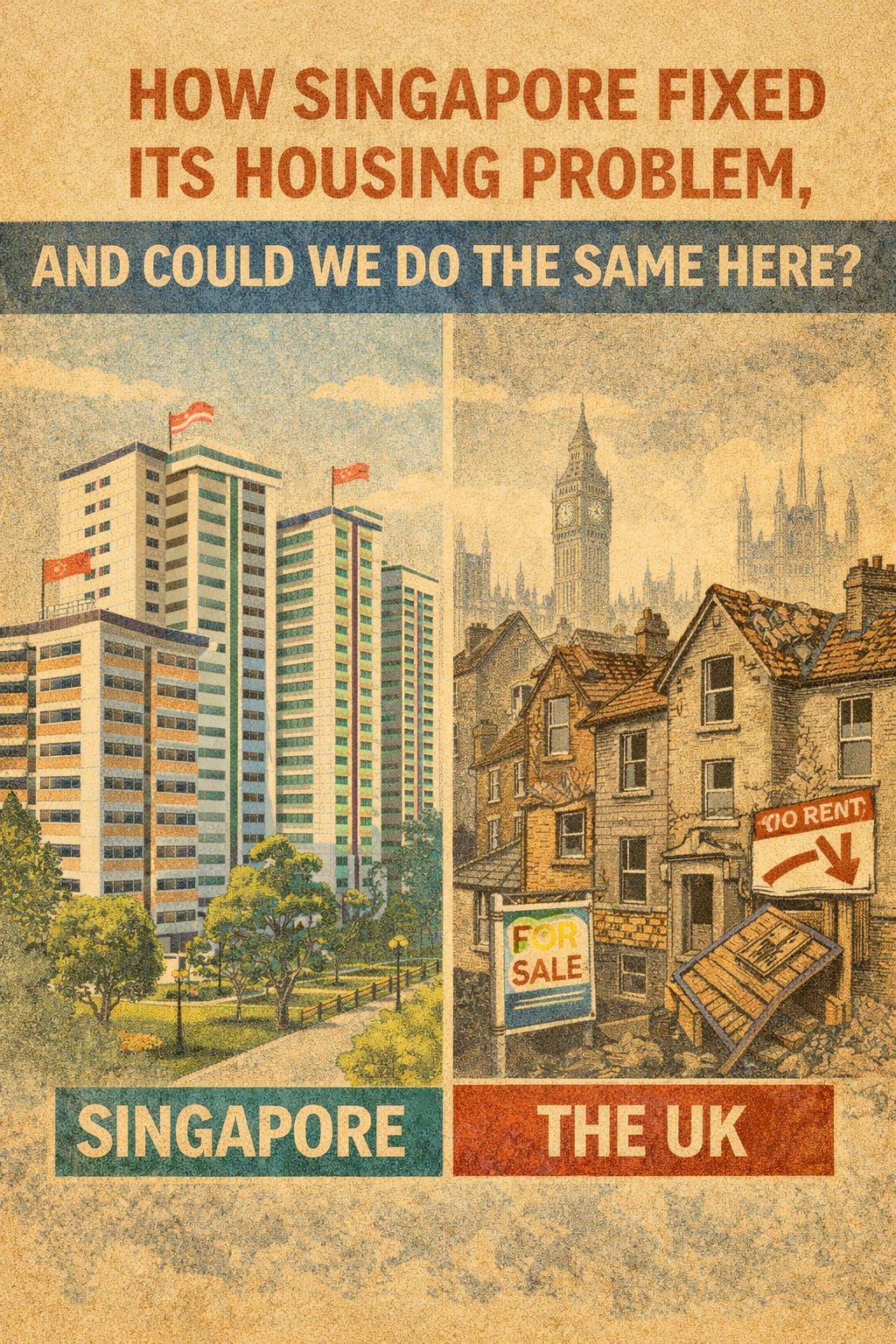
The UK has a serious housing crisis. Housing is growing increasingly unaffordable for many Brits. Despite numerous governments acknowledging the problem, all have failed to fix the issues.
Singapore offers a solution. Around 80% of Singapore’s population lives in publicly built housing, and most of those residents own their homes. This is the result of deliberate state intervention.
What Did Singapore Do?
Singapore gained self-government in the late 1950s, and housing conditions were awful. Much of the population lived in overcrowded slums or informal settlements. Fires, disease, and poor sanitation were common.
The government recognised that leaving housing to market forces would entrench inequality and social instability. Housing reform therefore became central to government strategy.
Singapore’s established the Housing and Development Board (HDB) in 1960. Unlike housing authorities in many other countries, the HDB were enabled to:
1. Build and maintained housing at massive scale.
2. Acquired land compulsorily at low cost.
3. Set prices and eligibility rules.
4. Coordinate housing with transport, schools, and jobs.
HDB housing was not only for the poorest but designed for the majority of the population, including middle-income households.
Singapore solved its housing shortage by building at scale and building fast. The state directly constructed hundreds of thousands of flats over several decades, ensuring supply consistently matched population growth.
Because the government controlled land and construction, it could prevent land speculation, keep prices stable, and avoid property bubbles that are common in private housing markets.
Housing supply was treated as infrastructure, similar to roads or utilities, rather than as a financial product.
The Result?
In Singapore, most public housing is owner-occupied, not rented. Residents buy long-term leases (typically 99 years) at subsidised prices. The result is high home ownership without reliance on risky private mortgages or speculative lending.
To ensure that housing does not become a speculative asset class—as it has done in the UK—the government maintains restrictions on who can buy public housing, minimum occupancy periods before resale, taxes on second properties and foreign ownership, and limits on how many properties an individual can own.
Housing is allowed to appreciate in value, but within tightly controlled bounds. The state intervenes whenever prices rise too quickly, prioritising social stability over investor returns.
Can The UK Copy Singapore?
Singapore’s success does not mean its model can be easily copied. For us to have any chance of achieving the change we need then we will require strong state capacity and political continuity. There will need to be public acceptance of extensive government intervention and the ownership of vast amounts of land by the state.
Housing policy plays an important role in social cohesion. Housing is a human right and shapes the social fabric of the nation. If we do not deal with the crisis then British society will continue to fracture. As housing becomes increasingly expensive and the wealthiest buy up more of the housing stock as speculative assets then public disaffection with politics will continue to grow.
We need a party that will deliver high quality, publicly built housing. With political will and energy, as well as public mass support, a British government could institute its own HDB to build the homes and regulate the market. Even fixing this one issue would make the government historically consequential.
Your vote is important, perhaps more now than ever before. If you want that vote to go to the right place, make sure to vote for the party that has a clear vision for the future of British housing.