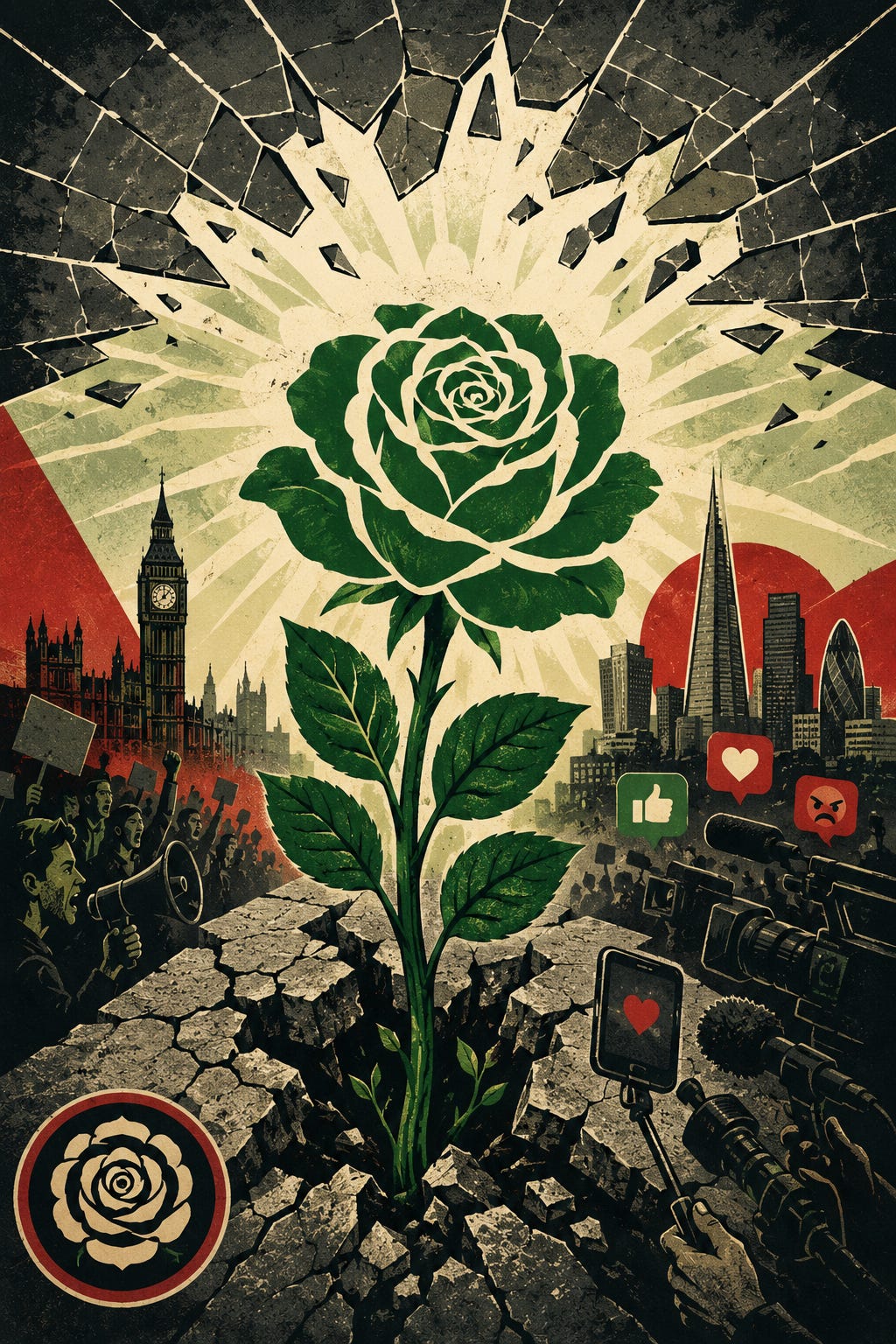
Zack Polanski has done something no Green leader has managed before. Membership has tripled, the party won its first by-election, and the Greens are now perceived as a real electoral threat by the Labour Party. And yet this week a poll put the Greens at their least popular ever under his leadership, worse than at any point before he took over. Something isn’t working, and it isn’t the policy offer.
The problem is the story. Right now, the Green Party are letting their national profile get written for them. Recognising a surging Green movement, the press has piled on scrutiny thick and fast. Stories including a spring conference row over a contested “Zionism is Racism” motion, candidates suspended and, in some cases, arrested over alleged antisemitic posts, and a party that looked slow and defensive in response. That’s a real story, and no comms strategy papers over bad candidate vetting.
But the deeper problem is that this is now the only story. Polanski’s actual politics like the wealth tax, the rent freezes, proportional representation, have been almost entirely displaced by a narrative he didn’t write and has struggled to answer on its own terms. You cannot out-argue a bad vibe. You can only replace it with a better one.
My suggestion is that the Greens lean into unseriousness. Not as a substitute for taking the scandal seriously, but as a separate strategy entirely. Being sharp, funny and self-aware about your own party is not the same as being sloppy about who you let stand as a candidate. Confusing the two is exactly how the party ends up doing neither well.
Building and Stalling
The Greens have always been popular with educated, conscientious, and politically active voters. For those who are consuming lots of political content, the Greens are visible and their policy platform is convincing. However, for most voters who don’t consume much politics, personality, vibes, and slogans mean more than the policy agenda.
Polanski came to prominence thanks to his feel-good vibes and ability to cut through the media landscape. Appearances on popular podcasts, The Last Leg, and snappy social media clips helped him reach younger voters. The whirlwind by which Polanski emerged on the public stage led to a historic surge in popularity.
There is no doubt that Polanski is a talented political operator. Able to light up spaces with a smile and a laugh and radiate positive energy. The problem is that many voters are not seeing this side of him. Many are only hearing the right-wing talking points. Polanski has stated on his podcast “Bold Politics” that he purposefully doesn’t platform ragebait figures to generate outrage. I understand this decision, but this is not how you beat the algorithm.
Without being far more combative and attention grabbing, the Green ceiling may only be as high as the audience it already has. A change in approach and adaptation to the algorithm may improve the reach, and increase the potential vote share.
Winning the Attention War
Social media rewards outrage and spectacle by design, not by accident, that’s simply the reality. Compare the register the Greens currently operate in: statements “condemning,” “calling for,” “expressing solidarity with.” Worthy, correct, forgettable. It’s the language of a pressure group, not a party trying to replace Labour.
Nigel Farage understands something the Greens haven’t yet: being memorable and being taken seriously aren’t in tension, they’re the same project. A pint in a pub does more for Reform’s brand than a hundred position papers — not because Farage is right about anything, but because he grasps that for most of the public, politics is downstream of personality and spectacle whether anyone likes it or not.
Farage is thin-skinned and facing his own political crisis, but this isn’t to say something cannot be learnt from his approach to politics. I have written about how comedy can reach apolitical voters, and this can be from both the left and the right. Currently, politicians from the right have made the best use of this strategy, perhaps because they are less conscientious and have less shame. It’s time the left learnt to have less shame, because the moment demands it.
Why This Will Work
The Greens have the raw material to do this well. They’re the most popular party by far among voters under thirty, and that generation’s entire media diet runs on absurdity, irony and the joyfully ridiculous. It’s the language TikTok speaks natively. The Greens need to lean into this. This doesn’t mean stopping BBC or Sky News appearances, but it does mean focusing on stunts and content that will reach a much larger, apolitical audience. Content that reaches those who don’t watch the news.
Practically, this doesn’t require a variety show. Send someone dressed as a landlord to a Reform press conference to hand out fake rent invoices. Stage a mock funeral for the NHS outside the DHSC. Project Wes Streeting’s own quotes onto a wall outside a hospital facing corridor care, Led By Donkeys style. Cheap, shareable, and impossible for lobby journalists to ignore, because they generate footage, not just quotes.
These stunts need to be designed to go viral, grab the headlines, and provide the opportunity to put forward a narrative. This is because comedy does something a press statement can’t: it can reach the masses, and it can make people like you. A party willing to respond with humour, rather than retreat into defensive legalese, signals something about its character that voters want to see. No “we take this extremely seriously” statement will shift a narrative, but a comedic acknowledgement and engagement with issues will reach the masses and win supporters.
Zohran Mamdani may only be a mayor, but he went from 0% name recognition to becoming the mayor of the richest city in the world with this approach (take a look at this video).
The Greens don’t have a popularity problem because their politics are unpopular — rent freezes and wealth taxes all poll well. They have a reach problem, and reach isn’t fixed with serious policy documents or traditional messaging. It’s fixed by showing people, repeatedly and visibly, who you actually are. Right now, the Greens’ image is being increasingly defined by other people’s headlines. It’s time the Greens answered it themselves — and made people laugh while they did it.
Why This Matter?
The Northern Rose is committed to progressive politics. Wealth inequality is out of control, and without addressing it, the state won’t have the resources to meet any of the crises ahead, from climate change to an ageing population. Any party willing to fight the billionaire class rather than court it has our support, which is exactly why a comms failure that lets scandal eclipse a genuinely radical platform matters. Polanski’s success pushes every other party to take that platform seriously. It’s worth the Greens fighting for the attention on their own terms, rather than ceding it to right-wing headlines. It’s time for the Greens to stop playing by the rules and start making their own.