

Defund and Demoralise: How NHS Mental Health Services Were Set Up to Fail (NHS Privatisation Part 1):
Dr. John Mulligan talks about the outstanding human cost of austerity in the NHS mental health services.
Dr. John Mulligan
For decades, NHS mental health services have been quietly collapsing in plain sight. Those of us working in health care have watched successive governments - Labour and Conservative - avoid the investment needed to deliver even a minimal standard of care to people with severe and enduring mental health difficulties. Mental health, especially secondary mental health care, has always been politically convenient to ignore: the public rarely sees it, the patients rarely have a platform, and the consequences rarely make front-page news. The result is a system that has become - and there is no polite way to say this - appalling, unsafe, and - at times - abusive.
If that sounds harsh, the facts are harsher still. People with severe mental health difficulties die on average 15–20 years earlier than the general population. Recent analyses indicate around 120 preventable deaths every single day among those receiving or needing mental health care. These are not obscure statistical footnotes - they are the predictable outcome of a system that has been stripped of staff, resources, and political attention. And yet, despite the scale of the harm, our government shows no urgency in addressing any of it. Ministers speak of “security,” but ignore the thousands dying early on their watch.
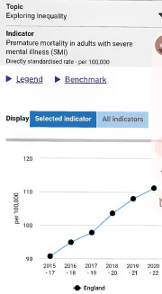
To understand how we got here, we have to acknowledge what has actually happened over the last 15 years: a deliberate defunding of essential care, a political unwillingness to confront the workforce crisis, and a demoralisation of staff that has pushed services into permanent collapse.
Austerity and the Managed Decline of NHS Mental Health Care
Austerity did not just “reduce spending.” It forced mental health services into a mode of survival where everything became about rationing: rationing beds, rationing therapy and rationing staff time. In community teams, caseloads ballooned to levels that would be considered dangerous anywhere else. A generation of skilled clinicians burned out or left entirely. Newly qualified staff entered teams where morale had already collapsed.
The cuts were not accidental - they were presented as “efficiency,” “modernisation,” or “targeted reform.” But what they actually created was a system where deaths and crises became normalised. The assumptions that once guided mental health practice - that people deserved long-term support, therapeutic care, and stability - were replaced with a mindset that prioritised throughput over wellbeing, and bureaucratic targets over compassion.
By the mid-2010s, many NHS trusts were quietly being forced to choose which services to keep alive. Day units disappeared. Group therapies shut down. Specialist teams shrank or were absorbed into generic “catch-all” services that could not cope with the complexity they were expected to manage. This wasn’t just short-term damage - this was the dismantling of whole ecosystems of care that took decades to build.
Preventable Deaths Treated as Administrative Inconvenience
The scale of premature mortality among people with severe mental health difficulties should have caused a national reckoning. Instead, it was met with political silence and routine bureaucratic statements about “ongoing challenges.” Even when official reports listed thousands of preventable deaths a year, the response was muted. No emergency taskforce. No rapid investment. No recognition that losing 15-20 years of life expectancy on the basis of having a mental health condition is a national scandal.
What this silence reveals is deeply uncomfortable: the state has become used to these deaths. They no longer register as political failures. They are treated as unfortunate but inevitable - which they emphatically are not.
Demoralised Staff, Disabled Services
Inside the NHS, the demoralisation of staff has become a defining feature of the crisis. Clinicians are repeatedly placed in positions where they know the care they’re providing is inadequate, unsafe, or entirely absent. They are forced to discharge people too early, decline referrals that should be accepted, and accept caseloads that are impossible to manage.
It’s destroying the workforce. Newly qualified practitioners are burning out within their first years. Services are increasingly filled with vacancies and temporary staff, creating instability that patients can feel immediately.
But the response from government has been to deny the problem, downplay the shortages, and publish long-term plans with no workforce data attached. The absence of a national workforce assessment is not an oversight. It is a political decision - because acknowledging the true staffing crisis would force an admission of failure.
A Government Strategy of Delay and Deflection
Every government of the last 20 years has promised to “transform” mental health care. Every one of them has delivered glossy strategies, ambitious targets, and slogans about “parity of esteem.” And yet none have addressed the structural reality: without staff and sustained investment, mental health care cannot function.
Instead, the modern approach has become one of delay. Delay the workforce plan. Delay the investment. Delay the publication of safety reviews. Delay the reforms. Delay the national debate about why tens of thousands of people are dying early. Delay everything, because delay keeps the crisis out of political view.
This is not neglect - it is managed decline.
The Political and Moral Implications
The refusal to address the mental health crisis is not simply a policy failure; it is a moral one. A society that allows tens of thousands of preventable deaths each year is a society that has decided certain lives matter less than others. The people dying early are often already marginalised - economically insecure, socially isolated, struggling with long-term conditions. Their deaths rarely spark outrage and they should.
The crisis in NHS mental health services is not inevitable. It is the outcome of choices: choices to underfund care, to ignore staff, to tolerate high mortality, and to allow safety standards to slide. If we continue down this path, the next decade will see further collapse, deeper inequalities, and an entrenched system where only the most privileged can access timely, high-quality mental health support.
This series will continue to explore not just how we arrived at this crisis, but the political and ideological forces that have shaped it - and the human cost of a system that has been allowed to fail.

A National Scandal - Neglecting Our Most Vulnerable with Dr. John Mulligan: The Northern Rose Podcast Ep.5

It was our pleasure to have Dr. John Mulligan as our guest this week. With over 20 years experience in mental health in the region, Dr. Mulligan has frequently reached out to the press to raise awareness about the devastating impact austerity has had on Manchester’s early intervention service.