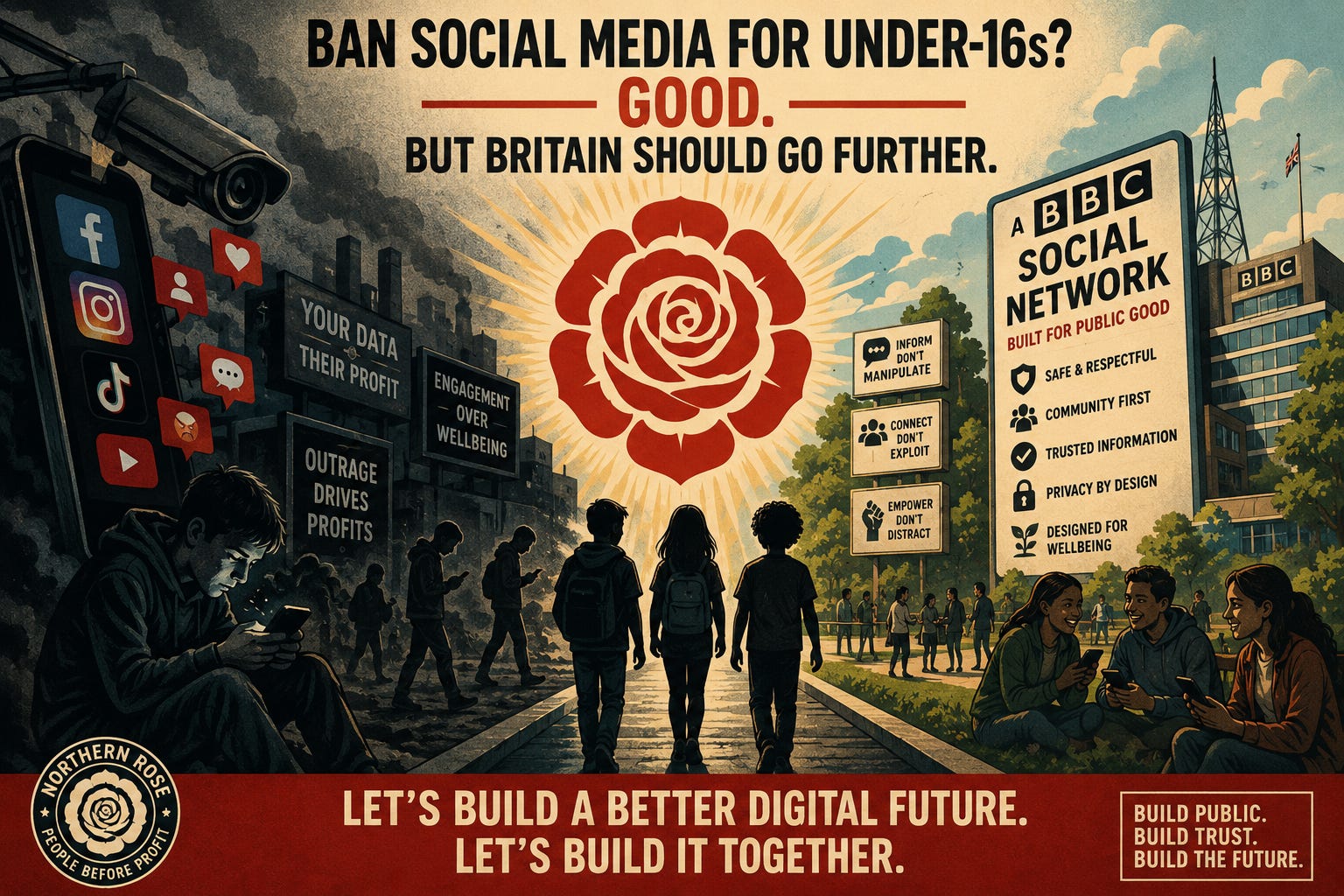
Ban Social Media for Under-16s? Good. But Britain Should Go Further and Build Its Own.
Starmer announces ban for under-16s in UK. What should come next?
The UK government’s plan to ban social media access for under-16s is correct. Social media companies exploit users and damage their mental health. These companies know about the harms they are creating and do nothing about it. Australia led the way, and now our government has chosen to take the same step.
I am not opposed to social media in principle. I think it could be an incredible tool used for many beneficial purposes. However, like any tool, it can also cause harm. Ultimately, the utility of social media depends on how it’s governed and run. If platforms were constructed for the benefit of the public and creators held accountable for the decisions they make, then we would not have the toxic platforms that we have today. Since the platforms have been constructed to extract as much profit from users as possible, no matter the cost to their mental health, bans are necessary. Yet, this doesn’t mean that we should ban all social media.
If we are serious about protecting children and rebuilding a healthier digital public sphere then we should ask a bigger question: why are we relying on a handful of American technology companies to shape our social lives in the first place?
Perhaps it is time for Britain to do something more ambitious: create a publicly owned social media platform.
The Social Media Experiment Has Failed
Social media was sold as a democratising force. It would connect communities, give ordinary people a voice, and strengthen civic participation. And it could still fulfil this promise.
Instead, platforms evolved into profit and data-extraction machines. Platforms make money by maximising engagement. The longer users remain online, the more advertisements they see. As a result, algorithms are designed not to inform us or make us happier, but to keep us scrolling.
The consequences are increasingly well understood.
Young people face unprecedented levels of online comparison and anxiety. Political debate is rewarded when it generates outrage rather than understanding. Conspiracy theories spread faster than fact checkers. Hate becomes profitable.
The problem is not merely bad content. The problem is that the platforms themselves are designed around incentives that prioritise engagement over wellbeing.
The Public Service Alternative
We’ve spoken about it before, and let’s reiterate it here. By building our own social media infrastructure, we could guarantee:
1. Genuine accountability. A British platform would be subject to British law in a meaningful sense, not through the clumsy reach of regulators who can fine Meta an amount that equates to pocket change, but through direct institutional accountability to Parliament, Ofcom, and ultimately us, the public.
2. Data protection with teeth. UK user data would remain under British jurisdiction, subject to the protections of domestic law rather than trusting foreign companies will act in trustworthy ways. This matters not just for privacy but for national security.
3. Editorial standards without editorial control. One of the core dilemmas of social media governance is the tension between free expression and harm prevention. A public institution would not be censoring speech; it would be applying the same editorial and regulatory principles that supposedly govern British broadcasting. It wouldn’t be perfect, but at least we’d have the power to refine our own principles, and they’d be subject to challenge, appeal, and the law.
4. Investment in British digital infrastructure. A serious UK platform would require engineering talent, data centres, content moderation teams, and product development. Those are skilled jobs, based here, contributing to the economy.
None of this would be particularly difficult. The UK has the expertise for building such a platform, and arguably this is now a matter of national security.
Banning under-16s from social media may protect the next generation from the worst harms of today’s platforms. Building our own could ensure they never have to choose between connection and exploitation in the first place.